
Best Real Estate Investment Strategy 2026
Table of Contents
- Real Estate Investment Strategy: Your Path to Wealth Building
- Buy-and-Hold: The Long-Term Rental Property Investing Approach
- Fix-and-Flip and BRRRR: Active Investment Strategies
- Real Estate Investment Property Types: Choosing What Works for You
- Real Estate Investment Analysis: Evaluating Your Opportunities
- Real Estate Investing Risks: Understanding Downside Scenarios
- Selecting Your Strategy: A Framework for Your Goals
- Frequently Asked Questions
Last Updated: October 19, 2026
Real Estate Investment Strategy: Your Path to Wealth Building
When I work with clients across Florida and Georgia, the question I hear most often isn't "Should I invest in real estate?" It's "What's the best real estate investment strategy for someone like me?" The answer depends on your timeline, risk tolerance, available capital, and income goals. I've spent over 25 years helping first-time buyers and seasoned investors navigate these decisions, and choosing the wrong strategy can cost you years of opportunity or expose you to unnecessary risk.
Real estate investment strategy refers to your overall approach to acquiring, managing, and profiting from property. Some strategies prioritize steady monthly cash flow, others chase appreciation, and still others require active work and capital to turn quick profits. The best strategy isn't the most impressive-sounding one, it's the one that aligns with your resources, tolerance for hands-on work, and financial timeline.
Buy-and-Hold: The Long-Term Rental Property Investing Approach
How Buy-and-Hold Works
Buy-and-hold is the most straightforward real estate investment strategy for building long-term wealth. You purchase a residential property, rent it to tenants, and hold it for years while collecting monthly rental income and benefiting from property appreciation.
The mechanics are simple: secure financing, purchase below market value when possible, find reliable tenants, and let time work in your favor. It requires less active management than fix-and-flip work while generating consistent income, and you build equity through two channels simultaneously: mortgage paydown and property appreciation.
The timeline matters: buy-and-hold typically requires holding at least 5-10 years to see meaningful wealth accumulation, since shorter periods let transaction costs eat into gains. Longer holds of 15, 20, or 30 years compound wealth significantly through both appreciation and mortgage payoff.
Cash Flow and Appreciation Potential
Two forces drive returns in buy-and-hold investing: monthly cash flow from rent and long-term appreciation of the property itself. Cash flow is the money left over after paying mortgage, property taxes, insurance, maintenance, and vacancy costs. Appreciation is the increase in the property's market value over time.
In strong markets, a well-selected rental generates positive cash flow from day one; in softer markets, you might break even or carry a small monthly loss, betting appreciation makes up the difference.
Most successful buy-and-hold investors target both simultaneously, looking for properties in growing markets where rents support positive cash flow and long-term appreciation is likely. This balanced approach reduces the risk that your strategy fails if either cash flow or appreciation underperforms.
Fix-and-Flip and BRRRR: Active Investment Strategies
Fix-and-Flip Fundamentals
Fix-and-flip is a real estate investment strategy built on speed and execution. You purchase an undervalued property, renovate it, and sell it for a profit, typically within 6-12 months. Unlike buy-and-hold, you're not holding for appreciation; you're creating value through renovation and selling at market rate.
Profit comes from the gap between your total investment (purchase price plus renovation costs) and the sale price. A successful flip requires accuracy: buy at the right price, control renovation costs, and execute the sale in a reasonable timeframe.
The challenge with fix-and-flip is execution risk: renovation costs often exceed estimates, market conditions can shift during your holding period, and holding costs (mortgage, taxes, insurance, utilities) accumulate while you work.
BRRRR Strategy Breakdown
BRRRR stands for Buy, Rehab, Rent, Refinance, Repeat. It's a hybrid approach that combines fix-and-flip execution with buy-and-hold wealth building. You purchase an undervalued property, renovate it, rent it out, refinance to pull out your initial capital, then repeat the process with the cash you recovered.
The appeal of BRRRR is that it lets you recycle your capital. Instead of selling and paying capital gains taxes, you refinance after the property is stabilized with tenants; if you've added enough value through renovation, the refinance can return most or all of your initial investment.
This real estate investment strategy requires more sophistication than simple buy-and-hold. You need accurate renovation budgets, the ability to quickly lease the property, and lender relationships that will refinance after value-add work.
Real Estate Investment Property Types: Choosing What Works for You
Single-Family vs. Multifamily Properties
Single-family rentals are the entry point for most investors: easier to finance with conventional loans, simpler to manage, and appealing to a broader tenant pool. They also appreciate in most markets and are straightforward to sell when you're ready to exit.
Multifamily properties (duplexes, triplexes, and apartment buildings) offer higher cash flow per dollar invested but require more sophisticated management and financing. Lenders often treat multifamily as commercial real estate, requiring larger down payments and more complex underwriting.
For most investors building their first real estate investment strategy, single-family rentals make sense. They're more forgiving, easier to finance, and provide a foundation for understanding how rental income, expenses, and appreciation work. As you gain experience and capital, multifamily properties become attractive.
Short-Term Rentals vs. Long-Term Rentals
Short-term rentals (rented nightly or weekly through platforms) generate higher monthly revenue than long-term rentals but require active management: turnover, cleaning, guest communication, and issues between stays. They also face regulatory uncertainty, as many municipalities have restricted or banned them.
Long-term rentals (annual leases) generate lower monthly revenue but require minimal active management once you find a quality tenant. They're more stable and predictable, making them easier to finance and manage.
The choice depends on your market and your willingness to manage actively. In tourist-heavy markets with strong short-term rental demand, the higher revenue can justify the extra work. In most markets, long-term rentals offer better risk-adjusted returns for passive investors.
Real Estate Investment Analysis: Evaluating Your Opportunities
Key Metrics: Cap Rate, Cash-on-Cash Return, and NOI
When evaluating a potential rental property investment, you need to understand three core metrics. Cap rate (capitalization rate) is the annual rental income divided by the property purchase price.
Cash-on-cash return measures annual cash flow divided by the cash you invested upfront.
Net operating income (NOI) is gross rental income minus operating expenses (taxes, insurance, maintenance, vacancy). NOI tells you how much profit the property generates before debt service.
These metrics help you compare properties objectively. A property with a 5% cap rate and 8% cash-on-cash return in a stable market might be better than a 7% cap rate property in a volatile market.
Schedule Your Free Call Today →
Market Analysis and Location Selection
Location drives everything in real estate. A property in a growing market with strong job growth, rising population, and increasing rents will appreciate faster and maintain higher occupancy than one in a declining area.
Markets with strong fundamentals, job growth above the national average, population growth, rising rents, and limited new supply, typically deliver better returns. Markets with declining employment, population loss, or oversupply carry higher risk. Your real estate investment strategy should prioritize markets with tailwinds, not headwinds.
Location within a market matters equally. A property in a desirable neighborhood with good schools, low crime, and proximity to employment centers will attract quality tenants and appreciate faster than one in a declining neighborhood.
Real Estate Investing Risks: Understanding Downside Scenarios
Vacancy, Market Downturns, and Financing Risk
Every real estate investment strategy carries risks. Vacancy, periods when the property sits empty between tenants, reduces cash flow. In strong markets, vacancy might be 5% annually. In weaker markets, it can exceed 15%. When you're analyzing cash flow, assume realistic vacancy rates for your market.
Market downturns can reduce property values and rental rates simultaneously. If you bought at the peak and a recession hits, your property might be worth less than your mortgage, particularly risky with an adjustable-rate mortgage or thin cash flow.
Financing risk emerges when interest rates rise or lending standards tighten. If you planned to refinance in three years and rates have jumped, the refinance might not work; with an ARM (adjustable-rate mortgage), rising rates increase your payment.
Mitigation Strategies and Due Diligence
Smart investors mitigate these risks through careful due diligence and conservative assumptions. Start by underwriting conservatively: assume higher vacancy, higher maintenance costs, and lower appreciation than you hope for. If the property still makes sense with conservative assumptions, it's worth pursuing.
Due diligence includes property inspections, market research, and tenant screening. A professional inspection reveals hidden issues before you buy, market research confirms rental demand and realistic rent assumptions, and quality tenant screening reduces vacancy risk and problem-tenant costs.
Build reserves into your real estate investment strategy. Set aside cash for unexpected maintenance, extended vacancies, and market downturns.
Selecting Your Strategy: A Framework for Your Goals
The best real estate investment strategy depends on four factors: your timeline, your available capital, your risk tolerance, and your willingness to work actively.
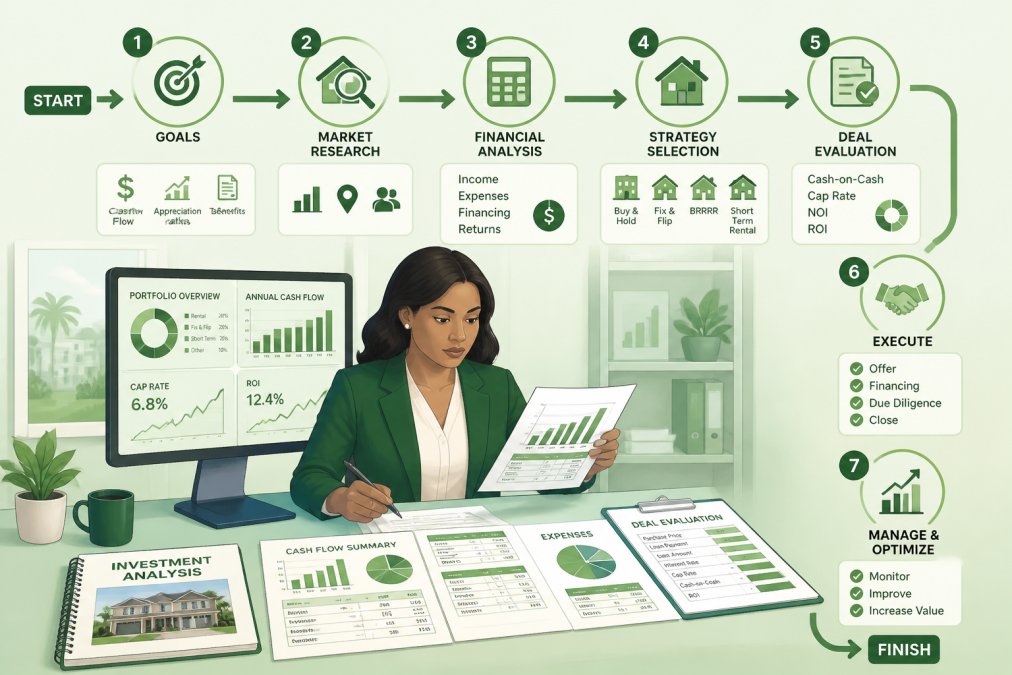
If you have 10+ years and want passive income, buy-and-hold in growing markets makes sense.
Your available capital matters enormously.
Risk tolerance shapes everything. Conservative investors gravitate toward buy-and-hold in stable markets. Aggressive investors pursue fix-and-flip in emerging markets.
Consider whether you want to be hands-on or passive. Fix-and-flip and short-term rentals require active involvement. Buy-and-hold with long-term tenants is largely passive once established. BRRRR sits in the middle.
My experience working with hundreds of investors shows that the best real estate investment strategy is the one you'll actually execute. An aggressive strategy you abandon midway generates no returns.
The real estate market in 2026 offers multiple pathways to wealth building, but the path that works depends on your unique situation. At Shawana Boyer, I've guided investors through each of these strategies across Florida and Georgia. Ready to build your real estate investment strategy? The National Association of Realtors market research and HUD housing market data provide current market context for your planning.
Frequently Asked Questions
What is the best real estate investment strategy for 2026?
The best strategy depends on your capital, timeline, and risk tolerance. Buy-and-hold works for patient investors seeking long-term wealth through rental income and appreciation. Fix-and-flip suits active investors with capital and renovation skills seeking faster returns. BRRRR combines both approaches, requiring more expertise and financing. Start by clarifying your income goals and how much time you can dedicate to management.
How do you compare cash flow and appreciation when choosing an investment property?
Cash flow is monthly rental income minus operating expenses; appreciation is property value growth over time. High-cash-flow properties in established markets generate immediate income but slower appreciation. High-appreciation properties in emerging markets offer long-term wealth but lower monthly returns. Align your choice with your timeline: need income now, prioritize cash flow; investing for 10+ years, balance both or lean toward appreciation.
What type of property is best for a first-time real estate investor?
Single-family rental properties are often ideal for first-time investors because they're easier to finance, manage, and understand. They have lower entry costs than multifamily properties and simpler tenant dynamics. Long-term rentals provide steadier income than short-term rentals, which require more active management. Start with one property to learn the business before scaling to a larger portfolio.
How can investors evaluate the risks of a real estate investment strategy?
Assess vacancy rates in your target market, local economic trends, and your own liquidity cushion for unexpected repairs. Run scenario analyses: what if vacancy hits 20% or mortgage rates rise 2%? Review property-level risks through inspections and title research. Diversify across property types, locations, and strategies to reduce exposure to any single market downturn or strategy failure.
What does rental property investing require in terms of capital and ongoing costs?
Capital requirements vary by strategy and property type, but most investors need a down payment, closing costs, and reserves for repairs and vacancies. Ongoing costs include mortgage payments, property taxes, insurance, maintenance, property management fees, and potential vacancy periods. Calculate your net operating income carefully: rental income minus all operating expenses determines whether a property generates positive cash flow.
How does the BRRRR strategy work in real estate investing?
BRRRR stands for Buy, Rehab, Rent, Refinance, Repeat. You purchase an undervalued property, renovate it to increase value, rent it out, then refinance to recover your initial capital and repeat the cycle. This strategy requires significant expertise, capital for renovations, and access to financing. It can accelerate wealth building but carries higher risk and complexity than simple buy-and-hold investing.
What metrics matter most in real estate investment analysis?
Cap rate (net operating income divided by property price) shows annual return. Cash-on-cash return measures annual cash profit against your initial cash investment. NOI (net operating income) is rental income minus operating expenses. Debt service coverage ratio ensures rental income covers your mortgage payments. Analyze all three together to avoid overpriced properties or cash-flow traps.
